Search engine optimization is changing quickly in 2026. Ranking on Google is no longer just about adding keywords to a page. Businesses need helpful content, a technically strong website, a good user experience, clear local signals, and content that answers what people are actually searching for.
The good news is that SEO does not have to be complicated. With the right strategy and consistent improvements, businesses can strengthen their search visibility and attract more relevant visitors.
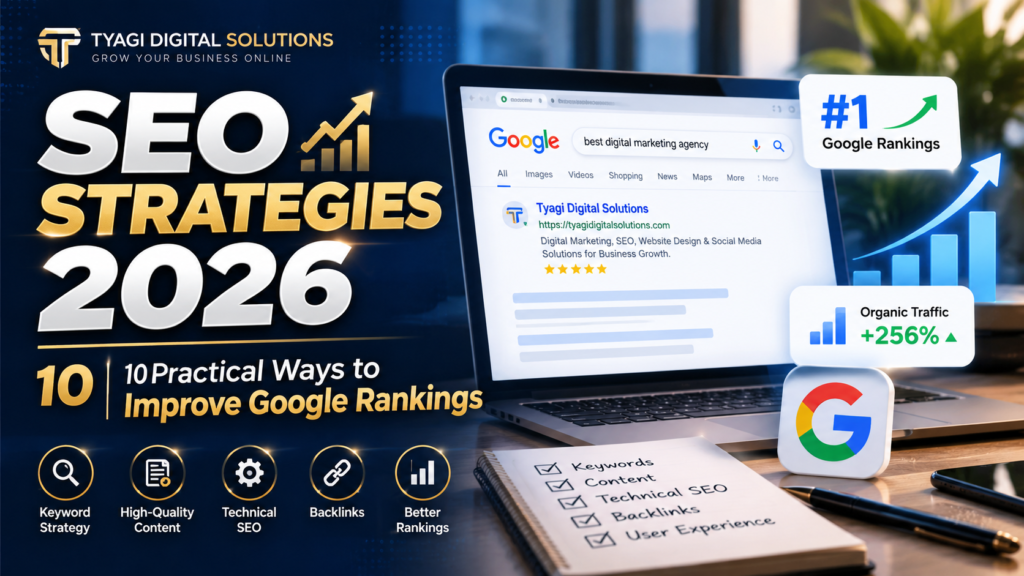
In this guide, we’ll cover 10 practical SEO strategies you can use in 2026 to build a stronger presence on Google and prepare your website for the changing search landscape.
1. Focus on Search Intent, Not Just Keywords
Keywords are still important, but understanding why someone is searching is even more important.
For example, someone searching for “SEO strategies 2026” may be looking for an agency, while someone searching for “how does SEO work” is probably looking for information.
Before creating a page or blog post, ask:
- What is the user trying to find?
- What problem are they trying to solve?
- What type of answer would be most useful?
- Are they researching, comparing options, or ready to contact a business?
Your content should match that intent instead of simply repeating a keyword multiple times.
2. Create Helpful, People-First Content
Good SEO content should be written for people first.
Avoid creating articles only to target search terms. Instead, provide useful information that genuinely helps the reader understand a topic or solve a problem.
Strong content should:
- Answer the main question clearly
- Use simple and understandable language
- Include useful examples where appropriate
- Be organised with clear headings
- Avoid unnecessary repetition
- Add original business knowledge or experience when available
A useful article is more likely to satisfy visitors and support your website’s long-term search visibility.
3. Improve Your Website’s Technical SEO
Great content can still struggle if search engines have difficulty crawling or understanding your website.
Technical SEO helps make your website easier for search engines to access and users to navigate.
Important areas to check include:
- HTTPS security
- Mobile responsiveness
- Crawlability
- XML sitemap
- Canonical URLs
- Broken links
- Redirects
- Page indexing
- Structured data where appropriate
You should also regularly review Google Search Console to identify indexing or crawling problems.
Technical SEO does not need to be unnecessarily complicated. Start by fixing issues that directly affect accessibility, crawling, indexing and user experience.
4. Improve Website Speed and Core Web Vitals
Nobody enjoys waiting for a slow website.
Page experience can affect how visitors interact with your website, especially on mobile devices. Large images, unnecessary scripts, excessive animations and poorly optimised plugins can make a website feel slow.
Some practical improvements include:
- Compressing images
- Using WebP or AVIF where appropriate
- Lazy-loading below-the-fold images
- Removing unnecessary plugins
- Reducing unused CSS and JavaScript
- Using effective browser caching
- Choosing reliable hosting
Do not optimise only for a perfect performance score. The real goal is to provide visitors with a fast and stable experience.
5. Strengthen Your On-Page SEO
On-page SEO helps search engines and visitors understand what each page is about.
Every important page should have a clear structure.
Pay attention to:
- SEO title
- Meta description
- Main H1 heading
- H2 and H3 subheadings
- Natural keyword placement
- Image alt text
- Descriptive URLs
- Internal links
- Relevant page content
For example, a page targeting SEO services should explain the service properly rather than simply repeating “SEO services” throughout the page.
Clarity and relevance are more valuable than keyword stuffing.
6. Build a Strong Internal Linking Structure
Internal links connect related pages on your own website.
For example, a blog discussing SEO strategies can naturally link readers to your Search Engine Optimization service page when they want professional help.
Internal linking can help:
- Visitors discover related information
- Search engines understand your website structure
- Important pages receive more contextual signals
- Reduce isolated pages with few internal connections
Use descriptive anchor text rather than repeatedly using phrases such as “click here.”
Every new article should ideally connect to relevant service pages and other useful articles where it makes sense.
7. Pay Attention to Local SEO
For businesses serving specific cities or areas, Local SEO can be particularly important.
A strong local presence helps search engines understand where a business operates and what it offers.
Businesses should keep their important information accurate and consistent, including:
- Business name
- Phone number
- Website
- Business category
- Service information
- Opening hours
- Location details where applicable
A well-maintained Google Business Profile, genuine customer reviews and relevant local content can also strengthen a business’s local search presence.
If your customers primarily come from a particular area, Local SEO should be part of your wider SEO strategy rather than an afterthought.
8. Build Authority With Relevant Backlinks
A backlink is a link from another website to your website.
However, backlink building should focus on quality and relevance, not simply collecting as many links as possible.
Useful opportunities may include:
- Relevant business directories
- Industry websites
- Local citations
- Genuine partnerships
- Digital PR
- Useful guest contributions
- Original resources that other websites want to reference
Avoid spammy link-building methods and low-quality websites created mainly for backlinks.
A smaller number of relevant and trustworthy links can be more valuable than a large number of poor-quality links.
9. Optimise Content for AI-Powered Search, AEO and GEO
Search is expanding beyond traditional lists of blue links.
Users increasingly expect direct answers, summaries and conversational search experiences. This makes Answer Engine Optimization (AEO) and Generative Engine Optimization (GEO) useful considerations alongside traditional SEO.
There is no special trick that guarantees inclusion in AI-generated answers. A practical approach is to make your content easier to understand, verify and extract.
Try to:
- Answer important questions directly
- Use descriptive headings
- Explain concepts clearly
- Include FAQs when genuinely useful
- Keep business information accurate
- Demonstrate real expertise and experience
- Support important claims with reliable sources
- Keep important content updated
SEO, AEO and GEO should complement each other rather than being treated as completely separate strategies.
10. Measure Results and Keep Improving
SEO is not a one-time activity.
After publishing or optimising your website, monitor how it performs and use the data to decide what to improve next.
Useful metrics can include:
- Organic clicks
- Search impressions
- Click-through rate
- Search queries
- Landing-page performance
- Indexing status
- Conversions or enquiries
Google Search Console can provide valuable information about how your website appears in Google Search.
Instead of changing everything at once, identify the biggest opportunities, make meaningful improvements and monitor the results over time.
You can also follow the official Google Search Central documentation to stay updated with Google’s SEO guidance and best practices.
What Is the Best SEO Strategy in 2026?
The best SEO strategy is not one individual technique.
A strong approach combines helpful content, technical SEO, search intent, good user experience, internal linking, relevant authority signals and continuous measurement.
Businesses should also structure important information clearly so that it can be understood across traditional search engines and newer AI-powered search experiences.
The objective should not simply be “ranking for more keywords.” The real goal is to become more visible when potential customers are searching for the products, services or information your business provides.
Frequently Asked Questions
Is SEO still important in 2026?
Yes. People still use search engines to research businesses, services, products and information. However, SEO continues to evolve as search engines and AI-powered discovery experiences change how information is presented.
How long does SEO take to show results?
There is no fixed timeline. Results depend on factors such as the website’s current condition, competition, technical issues, content quality, authority and the market being targeted. SEO should generally be treated as an ongoing strategy rather than a quick ranking method.
Does AI-generated search replace traditional SEO?
Not completely. AI-powered search changes how some information is discovered and presented, but websites still benefit from technically accessible pages, useful content, clear information and strong authority signals.
What is the difference between SEO, AEO and GEO?
SEO focuses on improving visibility in traditional search results.
AEO (Answer Engine Optimization) focuses on structuring information so that answer engines can easily understand and surface direct answers.
GEO (Generative Engine Optimization) focuses on making useful, credible and well-structured information easier for generative AI search experiences to understand and potentially reference.
These approaches overlap considerably and work best as part of one broader search strategy.
Can a small business do SEO?
Yes. Small businesses can start with strong service pages, technically sound websites, useful content, local optimisation, Google Business Profile management and consistent measurement. The right priorities depend on the business, location and competition.
Build a Stronger Search Presence
SEO in 2026 is less about shortcuts and more about creating a website that is genuinely useful, technically accessible and easy to understand.
Start with your audience. Understand what potential customers are searching for, create useful pages around those needs, maintain a technically healthy website and measure what actually generates visibility and enquiries.
Need help improving your business’s search visibility?
Tyagi Digital Solutions provides SEO, Local SEO, website development, content marketing and modern search optimization services based around your business goals.
Book a Free Consultation to discuss your website and digital growth opportunities.